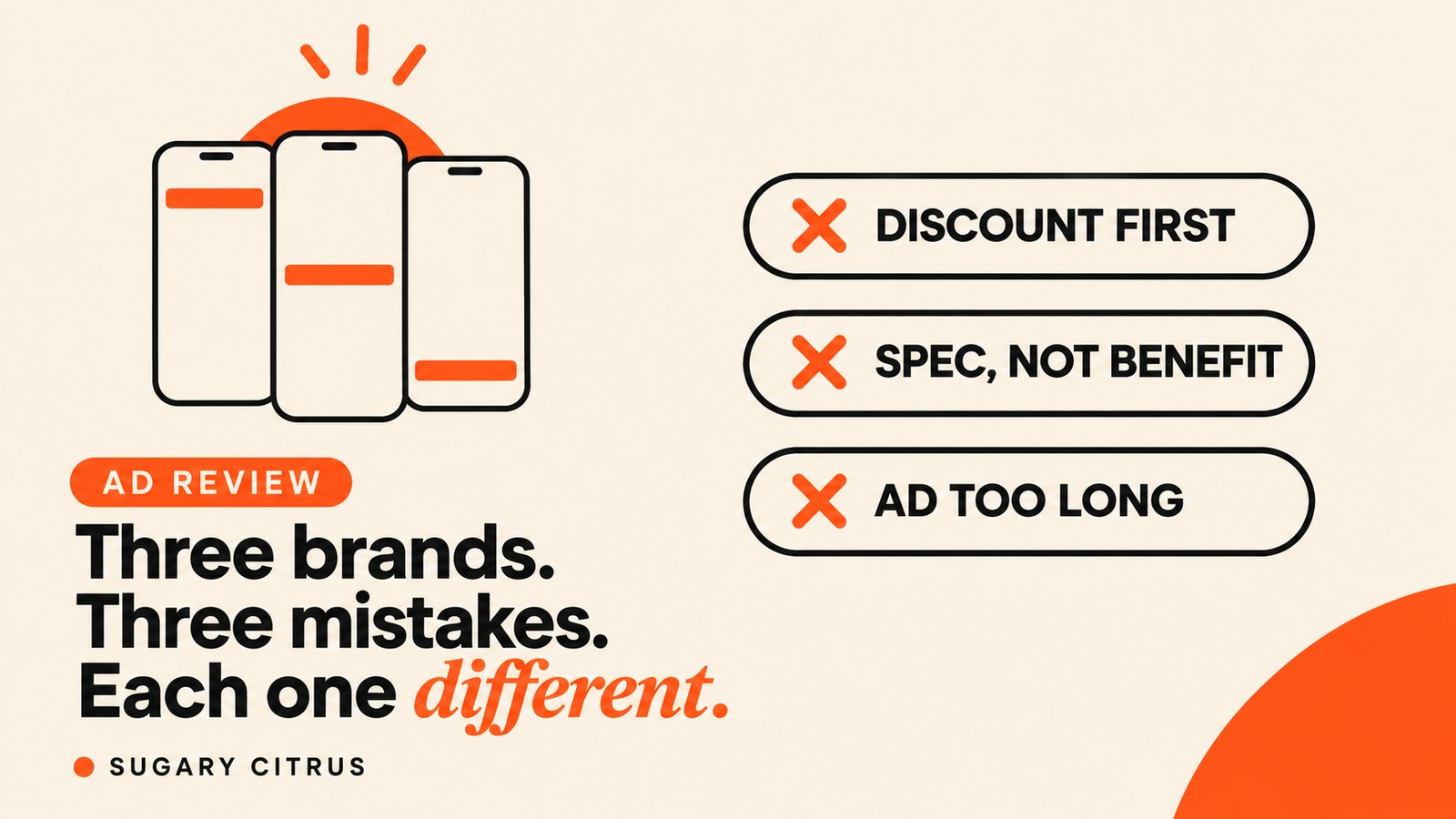
What I did
For each brand I recorded the live ads, the oldest start date, the format, the length, the copy and the destination, then opened the same products on the brand’s own store. Three brands is not a sample size — it is three companies in one category, each losing money in a place the others are not.
Meta does not publish spend, impressions, conversions or targeting for other advertisers. None of that appears here, and I have not guessed at it.
Brand A: the discount became the price
What the prices say
Brand A sells printed tees and denim. On its store, a boxy tee listed at Rs 1,799 sells for Rs 849. A graphic tee listed at Rs 799 sells for Rs 499. A striped tee listed at Rs 599 sells for Rs 399.
That is not one product in a sale window. It is the whole catalogue, at 33 to 53 per cent off.
The arithmetic is fine; the side effect is not. When every product sits at the same discount every day, the struck-through price stops being a reference point and becomes decoration. The customer learns in one visit that Rs 849 is the price, and Rs 1,799 is a number placed there to make Rs 849 feel like a decision.
What the ad says
The current creative opens with:
EXTRA 10% OFF ON OUR WEBSITE! WE HIT 100 CUSTOMERS!
A second discount stacked on a permanent one. If the brand runs a real festive promotion — 25 per cent off for Diwali — the customer has already been trained to expect 33 to 53 per cent as the everyday price, so the genuine offer looks worse than the normal one.
The same ad says “WE HIT 100 CUSTOMERS”. Honest and likeable — and it tells you where the brand is: the next hundred orders have to come from strangers, and strangers have no reason to trust a permanent discount.
The creative is 26 seconds of a person talking to camera. A text overlay does not appear until roughly eight seconds in, on a feed where the first two decide whether anything else is seen.
Brand B: the ad sells a specification instead of an outcome
What the ad does well
Brand B runs a ten-second product video. Three models, three tees, quick cuts. The opening text is a real hook — “3 tees. 3 vibes. Which one is yours?” — and the copy asks viewers to tag the friend who matches each one. Bundle pricing is clear: any two for Rs 1,799, any three for Rs 2,499, with free delivery and cash on delivery.
This is the best-executed creative of the three: right length, clear offer, and a bundle plus COD that removes two real objections at once.
Where it loses the sale
Then the ad says this:
240 GSM, 100% cotton, oversized fit.
240 GSM is a manufacturing specification — the number a fabric supplier quotes. A customer does not know what it feels like against the skin. They know three things: whether the tee goes see-through in sunlight, whether it loses shape after twenty washes, and whether it is wearable in a Delhi June.
None of those three are in the ad. The brand did the harder work — fabric, fit, bundle, COD — then described it in the language of the factory floor rather than the person wearing it.
The ad never shows a price. In ten seconds the viewer learns the GSM and the fit, not the number they would pay. The click has no anchor, so it becomes “let me go check the price” — and that is where people leave.
Brand B’s pricing is also permanently reduced, but gently: every oversized tee is Rs 999 against a listed Rs 1,299. A 23 per cent standing discount is a pricing decision, not a clearance, and it does not do the damage 50 per cent does.
Brand C: the footage nobody watched
What it gets right
Brand C is the most active advertiser of the three — ten live ads on the day I looked, the oldest running since 23 October. Every product on its store is Rs 2,400, with no struck-through price and no standing discount. That is the opposite of what the other two do: Brand C has decided its price is the price, and has not trained its customers to wait for a markdown.
What it gets wrong
What it gets wrong is length. Among those ten ads is a brand story running two minutes and twenty-six seconds. The founder sits in front of a wall hung with his own designs, holding a printed fabric sheet, talking through the incidents behind each one.
It is a good video. The wall is the best asset any of these three owns — his own designs in one frame, with the person who made them standing in front of it. No agency can produce that shot.
I cannot see its retention — Meta does not publish it — but two and a half minutes on a feed where the first three seconds decide everything is a video that gets served far more often than it gets finished. The same footage could become eight fifteen-second ads, one per design, each opening on that wall. Nothing needs re-shooting — it is an edit, not a production.
The three brands, side by side
Nothing here is estimated.
| Brand | Standing discount | Ad length | What the ad sells | Where it loses money |
|---|---|---|---|---|
| Brand A | 33 to 53 per cent, on every product | 26 seconds | A discount, then another discount | The hook lands at eight seconds, and the sale price has become the real price |
| Brand B | 23 per cent, uniform | 10 seconds | A fabric specification | The ad describes 240 GSM instead of what the customer gets, and shows no price |
| Brand C | None | Up to 2 min 26 s | A story | The best footage in the category runs too long to be watched |
What I would change, by brand
Brand A: set the real price and stop marking it down. If Rs 849 is the price, list Rs 849. Keep the struck-through price for two windows a year, and make those windows real. A discount only means something if it ends. Then move the hook to the first second — the current one lands at eight.
Brand B: replace the specification with the outcome it produces. Not “240 GSM” — “holds its shape after twenty washes.” Not “100% cotton” — “does not go see-through in sunlight.” Both of those have to be true of the actual garment; test before you write it. The specification belongs on the product page, for the person who has already decided to buy. And put the price in the ad: ten seconds is enough for a hook, one benefit and a number.
Brand C: cut the long video into short ones. If the footage already exists, the cost of testing eight hooks is editing time, not production. Everything else — the price discipline, the niche, the product — is already doing the work.
Before any of that, know your own number. The break-even ROAS calculator works out what a ROAS has to be once COGS, shipping, COD and RTO are counted — the figure a dashboard will never show you.
What eight Indian footwear brands' ad libraries actually show
After publishing the three reviews above, I pulled the Meta Ad Library for every Indian D2C footwear brand I could name, on 10 November 2026. Eight brands, all active on their own sites, all selling right now.
| Brand | Price | Active ads |
|---|---|---|
| echos above | Rs 8,950 | 22 |
| Vezzo | Rs 4,600 to 6,300 | 9 |
| BLYTH | Rs 3,499 | 2 |
| Hoofers | Rs 2,599 | 0 |
| NAAW | Rs 3,900 | 0 |
| Rockals | Rs 1,999 | 0 |
| Jenzya | Rs 1,299 | 0 |
| WORN IDEAS (apparel) | Rs 1,500 | 2 |
Four of the eight run no Meta ads at all. Not paused, not seasonal — no advertiser page found under the brand name. Two more run fewer than three ads, which is a test that never became a campaign.
The pattern that matters is the price column against the ad count. The two brands with the highest prices, echos above at Rs 8,950 and Vezzo at Rs 4,600, are the only two running a real programme. The four running nothing sit between Rs 1,299 and Rs 3,900.
That is the opposite of what most people assume. The usual story is that small brands cannot afford ads and big ones can. What this sample shows is that the brands charging more are the ones advertising. That is consistent with a higher price leaving room for a customer acquisition cost that works, but three brands cannot prove a cause. A Rs 1,299 shoe has to sell roughly seven times as many units to fund the same ad budget.
It also means the four brands running nothing are not short of a media buyer. They are short of a price and a reason. Advertising a Rs 1,999 sneaker that is permanently 47 per cent off is hard, because the offer has already taught the customer to wait.
Method: Meta Ad Library, active status, India, read 10 November 2026. Brands were found through category search, then checked by advertiser page. Spend, impressions and targeting are not public and are not used here.
How to check your own account in twenty minutes
The same audit, applied to one brand. No tools needed.
One. Open your store on a phone, logged out. Is every product struck through? Then you do not have a sale, you have a price with a story attached.
Two. Watch your last three ads on mute and stop at one second. If you cannot tell what is being sold, most of your spend reached people who had already scrolled.
Three. Count the words in your ad copy that a customer would actually use. “240 GSM” and “drop-shoulder” are yours, not theirs. Keep one specification on the product page and replace the rest with what changes for the person wearing it.
Four. Find your longest live ad. Over 40 seconds and not built around a single offer means it is being served to people who never reach the end.
Five. Ask what would still sell if you stopped discounting tomorrow. If the answer is nothing, the ad account is not the problem — the offer is.
What this cannot tell you
Three brands are not a market. If you want the fuller picture, I keep a running note on what AI placements cost in India. I did not see spend, conversions, ROAS or targeting, because Meta does not publish them, and it is entirely possible that all three are profitable and I am describing decisions that work. What I can say is that these are three different failures, not one shared one. A brand reading this should recognise at most one of them — and if it recognises all three, the problem is not the ads.
FAQ
Why are the brands anonymised?
The point is the decision, not the company. Named brands would turn this into a callout. Anonymised, a reader can check whether they recognise the behaviour in their own account.
Is a standing discount always a mistake?
No. Brand B runs a uniform 23 per cent and that reads as a pricing decision. The problem starts when the discount is deep enough that the struck-through price stops being believable — and when a second one is stacked on top.
What should replace a specification like 240 GSM?
The outcome it produces. Not the fabric weight, but whether the tee goes see-through in sunlight and holds its shape after twenty washes. Keep the specification on the product page, for the person who has already decided to buy.
How long should a Meta ad be?
Under 30 seconds for direct response, and shorter than that if the hook is not in the first two seconds. Long-form works when it has a different job — a brand story, a founder video — but it should not be the only thing you are running.
Sources
| Source | What it provided | When |
|---|---|---|
| Meta Ad Library | Active ad records for each brand: creative, copy, run dates and platforms | Read 6 November 2026 |
| Brand stores | Product names, prices, discounts and review counts, read on each brand’s own site | Read 8 November 2026 |
| Underlying records | The full Ad Library records behind this review | Shown privately on request |